Basic Information
| Attribute | Details |
|---|---|
| Full Name | Yuri Viktorovich Sharapov |
| Birth Year | Approximately 1958 |
| Birthplace | Gomel, Byelorussian SSR (now Belarus) |
| Death Year | 2026 |
| Age at Death | 68 |
| Cause of Death | Brain cancer |
| Spouse | Yelena Sharapova |
| Children | Maria Sharapova (born April 19, 1987) |
| Occupation | Builder, oil worker, tennis coach |
| Notable Role | Father and coach to Maria Sharapova |
Early Life and Roots
Born about 1958 in Gomel, a city in modern-day Belarus, Yuri Sharapov emerged from the industrial smog of the Soviet era. This humble start laid the groundwork for a life of quiet resolve. He received construction training as a young guy and built buildings in the bleak Byelorussian SSR settings. In 1986, everything drastically changed. Over his environment, a toxic shadow was cast by the Chernobyl nuclear accident, which exploded only 30 kilometers distant. Yuri uprooted his small family out of fear of the invisible pull of infection. He moved eastward to Nyagan in Siberia with his wife, Yelena, who was then a university student. Yuri took up hard labor there to give stability in the bitterly cold oil fields. On April 19, 1987, their daughter Maria came, bringing hope to the otherwise icy landscape.
The family relocated to Sochi on the Black Sea coast of Russia in 1990 in search of calmer climates. Yuri’s journey and destiny met here. In 1991, four-year-old Maria was first exposed to tennis through a friendship with Aleksandr Kafelnikov, the father of future champion Yevgeny Kafelnikov. Yuri started taking casual lessons in the neighborhood parks after recognizing her natural potential like a miner finding gold. These early, straightforward yet unrelenting drills set the stage for what would eventually become a worldwide sensation. At a Moscow clinic in 1993, six-year-old Maria caught the attention of tennis legend Martina Navratilova. She gave obvious advice: if you want genuine opportunities, go to America. Ever the practical person, Yuri answered the call.
Family Bonds and Sacrifices
A family built through hardship, like a ship enduring unrelenting storms, is at the core of Yuri’s tale. Yelena Sharapova, his late 1960s-born wife, provided a cerebral counterpoint to Yuri’s practical work ethic. Yelena prioritized schooling and emotional anchoring while she was a student when Maria was born. Due to visa issues, Yelena remained in Russia for two years when Yuri and Maria, then seven years old, traveled to Florida in 1994 with just $700 borrowed. Bridging the gap across the Atlantic, she wrote messages of encouragement. Their relationships were put to the test by this separation, but their commitment was strengthened. In 1996, Yelena returned to them, completing the triangle that would help Maria advance.
Yuri’s only kid, Maria Sharapova, became the family’s guiding light. She was born in Nyagan, in the remoteness of Siberia, and inherited her father’s uncompromising work ethic. Yuri turned parks into training grounds and began coaching her at the age of four. In order to pay for her lessons at the Nick Bollettieri Tennis Academy, Yuri worked odd jobs including construction, dishwashing, and shelf stocking after moving to the United States in 1994. Neither of them knew English. Later, Maria considered this to be a “miracle” that Yuri had faith in. Quieter by temperament, Yelena insisted on having a “Plan B”—a house in Russia as a backup plan in case tennis didn’t work out. This insight highlighted their practical strategy. Family dynamics changed over time. As Maria wanted independence, tensions increased, but they eventually subsided, as seen by her 2025 Hall of Fame plaque in which she referred to Yuri as her “greatest gift.”
The relationships between the Sharapovs created a fabric of tension and support. Yuri’s passion contrasted with Yelena’s serenity, establishing a harmonious environment for Maria’s development. There were no siblings to add complexity to the dynamic; attention was always on Maria’s rise. Rifts were hinted at by gossip, such as a purported 2009 breakup over Maria’s private life, but these storms passed and left a legacy of harmony.
Coaching Career and Achievements
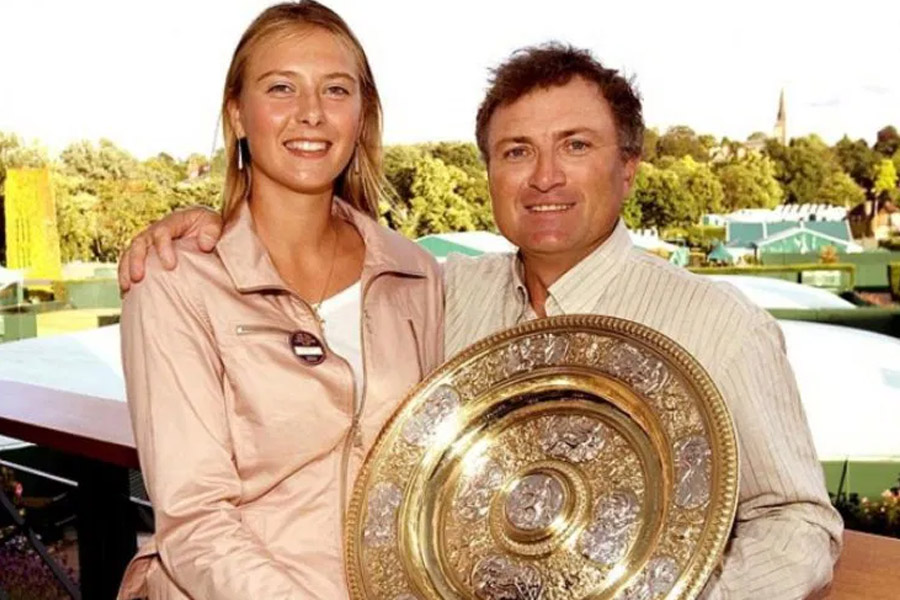
Yuri’s career morphed from blue-collar labor to courtside strategist, a transformation as swift as a tennis volley. From 1994 to 2008, he served as Maria’s primary coach, guiding her to five Grand Slam titles and the world No. 1 ranking in 2005. His methods, born of necessity, emphasized endurance and precision. In 2004, Maria’s Wimbledon victory at 17 against Serena Williams marked a pinnacle; Yuri’s role was pivotal, though his match-side signals—like gesturing with bananas—drew scrutiny and a 2008 WTA ban.
Post-2008, after Maria’s shoulder surgery, Yuri stepped back, allowing coaches like Michael Joyce to take over. He returned briefly in 2013 following Maria’s split with Jimmy Connors. Achievements tallied indirectly through Maria: over $38 million in prize money, a net worth estimated at $180-220 million, and ventures like her Sugarpova brand worth $20 million. Yuri’s net worth remained unquantified, tied to family success. His advisory influence persisted, shaping business decisions.
Key milestones pepper his timeline. In 1991, Maria’s first racket swing. The 1994 emigration. 2004’s Wimbledon glory. 2006 U.S. Open win. 2008 Australian Open triumph. 2012 and 2014 French Open victories. These dates etch a narrative of ascent, with Yuri as the unseen architect.
| Year | Achievement Milestone |
|---|---|
| 1991 | Introduces Maria to tennis at age 4 |
| 1994 | Moves to U.S. with Maria; begins coaching |
| 2004 | Maria wins Wimbledon |
| 2005 | Maria reaches World No. 1 |
| 2006 | Maria wins U.S. Open |
| 2008 | Maria wins Australian Open; Yuri steps back |
| 2012 | Maria wins French Open |
| 2013 | Brief coaching return |
| 2014 | Maria wins second French Open |
Challenges and Controversies
No ascent lacks thorns, and Yuri’s journey pricked with criticism. Labeled “volatile” during matches, he earned comparisons to infamous tennis parents like Damir Dokic. In 2004, media dubbed his behavior “outrageous,” spotlighting intensity that bordered on overbearing. A 2005 Guardian article even misspoke his name, underscoring outsider status. The 2008 signaling ban stemmed from such antics, forcing adaptation.
Gossip swirled like court dust. Rumors of a 2009 family rift, possibly over Maria’s relationships, hinted at control clashes. Sources painted Yuri as demanding, a “taskmaster” contrasting Richard Williams’ style. Yet, praise balanced barbs; Maria credited his resilience, like borrowing funds for their 1994 move. Controversies faded, but they humanized Yuri, revealing the pressure cooker of elite sports parenting.
Later Years and Legacy
As years advanced, Yuri’s role softened into advisory elder, a quiet harbor after turbulent seas. In 2024-2025, Maria’s interviews and podcasts highlighted his life lessons, from Siberian grit to “Plan B” wisdom. August 2025 brought a poignant moment: Yuri attended Maria’s International Tennis Hall of Fame induction in Newport, Rhode Island. Her tearful tribute—”Dad, we really did this together”—moved him visibly, a rare crack in his stoic facade.
Tragedy struck in early 2026. Yuri passed at 68 from brain cancer, prompting Maria’s January 6 Instagram homage recalling their sparse 1994 arrival. Social media tributes flooded, fans revisiting his coaching era. His legacy endures through Maria’s feats: 35 WTA titles, Olympic silver in 2012, and post-2020 retirement ventures. Yuri’s story, one of immigrant tenacity, inspires as a blueprint for parental devotion.
| Year | Later Life Event |
|---|---|
| 2024 | Maria reflects on Yuri’s influence in interviews |
| 2025 | Attends Maria’s Hall of Fame induction |
| 2026 | Passes away from brain cancer |
FAQ
Who was Yuri Sharapov’s spouse?
Yelena Sharapova, a former university student, provided emotional stability and joined Yuri and Maria in the U.S. in 1996 after a two-year visa delay.
What was Yuri Sharapov’s primary occupation before coaching?
He worked as a builder in Belarus and later as an oil field worker in Siberia, roles that funded the family’s early relocations.
How many Grand Slam titles did Maria Sharapova win under Yuri’s coaching?
Maria won five Grand Slams with Yuri’s guidance, including Wimbledon in 2004, U.S. Open in 2006, Australian Open in 2008, and French Opens in 2012 and 2014.
What prompted the Sharapov family’s move from Gomel?
Fears of radiation from the 1986 Chernobyl disaster, just 30 kilometers away, drove them to relocate eastward for safety.
When did Yuri Sharapov die?
Yuri passed away in early January 2026 at age 68 from brain cancer, as shared in Maria’s emotional tribute.
What controversies surrounded Yuri’s coaching style?
Critics labeled him overbearing for match signaling and volatility, leading to a 2008 WTA ban and comparisons to other intense tennis parents.
Did Yuri Sharapov have any other children besides Maria?
No, Maria was his only known child, with the family’s focus centered entirely on her development and career.