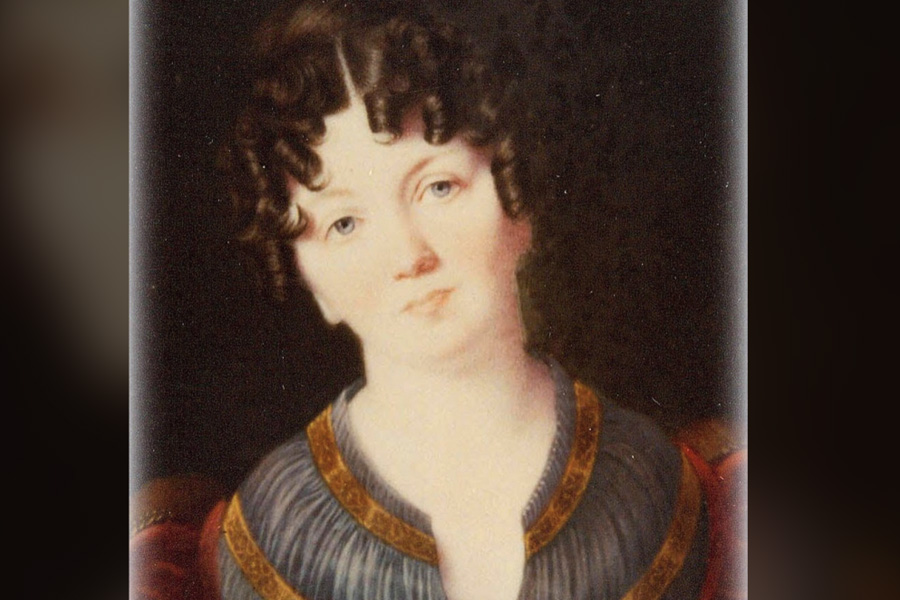
A daughter formed by politics and distance
I think Eliza Monroe Hay is one of those historical figures who stands at the edge of a famous life and yet quietly carries much of its weight. She was born in early December 1786, likely in Virginia, and she entered the world as the eldest daughter of James Monroe and Elizabeth Kortright Monroe. That detail alone places her inside one of the most recognizable political families of the early republic. Her father would become the fifth president of the United States. Her mother would become first lady. Eliza herself would become the steady hand behind the family’s public face when illness and duty pulled the household in different directions.
Her childhood was not a still portrait. It moved across borders and into diplomatic life. She spent part of her youth in France, where her father served abroad, and that European education gave her polish, language, and a social confidence that later mattered in Washington and Paris alike. I picture that upbringing as a ribbon stretched between two worlds, tied at one end to Virginia and at the other to Europe. She was raised in a family that lived with power, but also with uncertainty, travel, and expectation.
James Monroe and Elizabeth Kortright Monroe
Eliza’s father, James Monroe, changed politics. Eliza’s family was centered on stability rather than grandeur, although he was a public figure, statesman, and president. Mother Elizabeth Kortright Monroe brought a distinct force home. Although born in New York, her health often curtailed her public participation. Eliza was indispensable throughout the presidency due to her illness.
I see an inheritance-transfer relationship. Eliza learned public language from James Monroe. Elizabeth Monroe required her to fill gaps and hold the room together where others could not. When Monroe needed a hostess, Eliza volunteered. She managed social events, ceremonial receptions, and presidential household etiquette. Such work was not decorative. Political work in silk gloves. She connected intimate family responsibility to national ceremony.
Siblings and the shape of the household
Eliza had one younger brother and one younger sister. The brother was James Spence Monroe. His life was brief, and his early death left the household smaller and more fragile. The sister was Maria Hester Monroe, later Maria Hester Monroe Gouverneur after marriage. Maria lived long enough to become part of the family’s later troubles, especially the fight over inheritance and care.
The Monroe home was therefore not crowded, but it was emotionally dense. Three children, two of whom survived into adulthood, one who died very young, and parents who were often burdened by public duty and poor health. I think that kind of household teaches a person to notice absence. Eliza grew up in a family where each role mattered because there were so few people to carry them.
Marriage to George Hay and the private life behind public duty
In 1808, Eliza married George Hay, a Virginia lawyer and judge. The marriage linked her to another prominent legal and political world, but it also gave her a domestic life of her own. George Hay was not simply a title beside her name. He was her partner, her husband, and the father of her only child. Their life together appears to have been close and companionable.
Their daughter, Hortensia Hay Rogers, was born in 1809. That name, Hortensia, carried the trace of France and of Eliza’s earlier friendships there. It also reminds me how much Eliza’s life was built from memory, connection, and relocation. She never lived in one narrow lane. Her family tree spread like a river delta, with roots in Virginia, New York, and Europe.
When George Hay died in 1830, Eliza lost a major part of her private world. That death came near the same moment as her mother’s final illness. It was a hard season, a season of collapsing pillars. Her father died the next year. By then, the family structure had become less like a house and more like a ruin with a few standing walls.
The larger family network
Eliza’s maternal grandparents were Lawrence Kortright and Hannah Aspinwall Kortright. Their New York mercantile background helped explain the family’s broader social position and transatlantic reach. Her paternal grandparents were Spence Monroe and Elizabeth Jones Monroe. Through them, she inherited the Virginia world of land, lineage, and local standing that shaped her father’s rise.
She also had an aunt, Elizabeth Monroe Buckner, James Monroe’s sister. Aunts often disappear in political biographies, but they matter because family life is made of such quieter bonds. Even when the archive speaks most loudly about presidents and first ladies, there are these side branches that support the trunk.
When I trace Eliza’s family, I see a compact but influential circle. Father, mother, brother, sister, husband, daughter, grandparents, aunt. That is not a sprawling clan. It is a small constellation, and each point pulled on her life in a distinct way.
Wealth, inheritance, and the long decline
Eliza is financially disappointed. James Monroe planned to leave his daughters an inheritance, but it failed. Eliza was undersupported, and family dispute and Monroe’s documents and property seem to have made matters worse.
Her biography is heartbreaking because it demonstrates how a woman near the center of national history can die in poverty. She was hardly a delicate background figure. She was capable yet her circumstances limited her. She sought care in Paris later in life, unwell and struggling. I remember the image because it conveys dignity and exposure. It’s like seeing a beautiful mansion with one window lit after a storm.
Final years in Paris and remembrance
Eliza died in Paris on January 27, 1840. She was buried in Père Lachaise Cemetery, far from the country that had shaped her family name. Her burial abroad feels symbolic. The daughter of an American president, a woman formed by transatlantic life, ended her days in exile from both comfort and certainty.
Yet her story did not remain frozen there. In recent years historians have returned to her letters, her role in the White House, her financial distress, and her family’s treatment of her inheritance. Her remains were later brought back to Virginia and reinterred with family. That act mattered. It did not erase the loss, but it restored her place inside the Monroe story.
FAQ
Who was Eliza Monroe Hay?
Eliza Monroe Hay was the eldest daughter of James Monroe and Elizabeth Kortright Monroe, the wife of George Hay, and the mother of Hortensia Hay Rogers. She also served as an important hostess and social presence during her father’s presidency.
Why is she important in the Monroe family?
She was the family member who carried much of the public social burden when her mother was ill. She also became a key figure in later efforts to understand the Monroe family’s private struggles, especially inheritance and care.
Who were her closest family members?
Her closest family members were her parents James Monroe and Elizabeth Kortright Monroe, her brother James Spence Monroe, her sister Maria Hester Monroe Gouverneur, her husband George Hay, and her daughter Hortensia Hay Rogers.
What happened to her financially?
She did not receive the inheritance and support that had been expected from James Monroe’s estate. Her later years were marked by financial distress, and she died in difficult circumstances in Paris.
Where did she spend her final years?
She spent her final years in Paris, where she died in 1840. Her burial there reflected the international shape of her life, but later reinterment returned her to Virginia family soil.