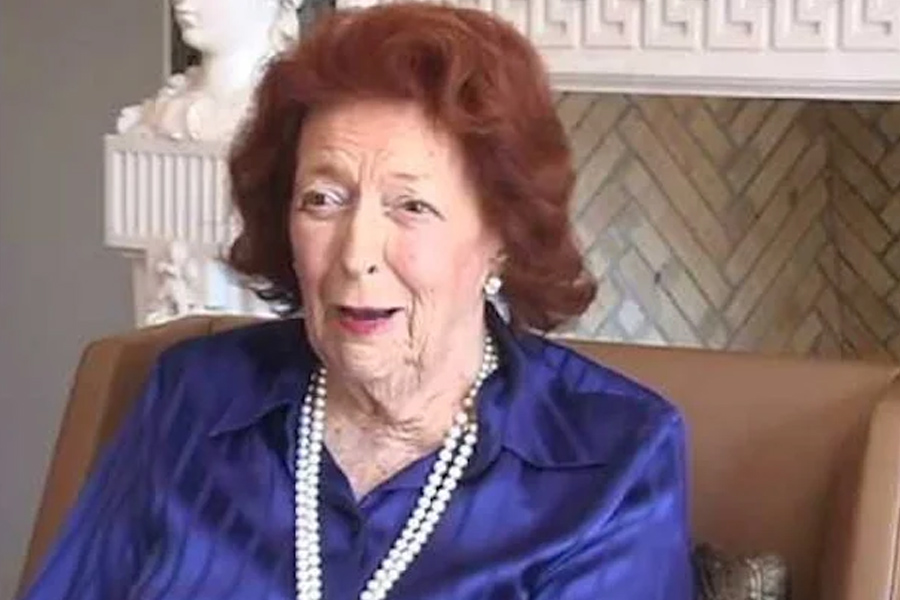
The woman behind the name
I think Teddy Getty Gaston is one of those figures whose life feels larger than the labels attached to it. She was born as Louise Dudley Theodora Lynch in 1913, but the name Teddy Getty Gaston became the one that carried her through music, marriage, grief, reinvention, and old age. She moved through the twentieth century like a flame in a drafty room, flickering brightly, never staying still for long.
I see her first as a performer. She sang, she studied opera, she moved through New York nightlife with the confidence of someone who knew her own voice mattered. In the 1930s, when glamour could still hide hard edges, she worked in clubs and on stage, and she had the sort of presence that made people lean in. A torch singer can sound fragile, but that is never the whole truth. There is steel underneath the smoke. Teddy had that steel.
Her life was also shaped by movement between worlds. She went from Chicago to New York, from the stage to Europe, from public rooms to private sorrow. That motion mattered. It gave her range, but it also left her exposed. She was not just a society woman orbiting wealth. She was a woman trying to build a self in a world that kept trying to define her by the men around her.
Family roots and the early storm
Teddy’s family story begins in Chicago, and like many family stories, it carries both polish and fracture. Her background included the Lytton and Ware lines, and her childhood was marked by instability, especially through the figure of her stepfather, Francis Joseph Lynch. In the telling that reaches us through later interviews and memoir material, that home was not a soft landing. It was a place of fear, bitterness, and lasting scars.
That early pain matters because it helps explain the force of her later life. Some people become smaller after hardship. Teddy seemed to become more determined to claim the world on her own terms. She took her own name, her stage name, and later the famous Getty name, and used each one as a key to another door.
Her maternal grandfather, Henry C. Lytton, gave the family a place in Chicago business society, but social standing is not the same as emotional shelter. Teddy’s early life appears to have been a mix of privilege and damage, a house with elegant curtains and rough walls behind them. That contradiction followed her into adulthood.
J. Paul Getty and the great marriage machine
In the mid-1930s, Teddy met J. Paul Getty while singing in New York. He was rich, ambitious, and heading toward the industrial myth that makes headlines. She was gorgeous, talented, and stubborn enough to resist swallowing. In the late 1930s, Getty married in Rome, his longest marriage.
Their connection involves appetite and constraint. Getty was notoriously wealthy and powerful. Teddy was charming, witty, and wanted to preserve some of herself. The marriage produced a son, Timothy Christopher Ware Getty, but also pressure, distance, and sadness.
Teddy’s relationship with Getty wasn’t all oil and magic. A house with several closed chambers. Glamour, control, emotional detachment, and the burden of living with a man who considers affection like a budget line were all there. Her prenuptial agreement. She navigated a costly world. She learned to be admired and constrained.
Her life revolved around their son Timmy. A brain tumor blinded and killed him young. All else faded after that loss. Child death is a storm that changes the landscape. Her narrative became tragic and human. Teddy’s love and pain were not opposites. They lived nearby.
Timothy, the son who became the wound and the cause
Timothy Getty, often called Timmy, is impossible to separate from Teddy’s own identity. He was her only child with J. Paul Getty, and his illness became one of the defining heartbreaks of her life. When a parent loses a child, the calendar seems to split in two. Before. After. Teddy carried that divide for the rest of her life.
What stands out to me is that she did not only grieve privately. She turned some of that grief into action, creating a foundation in Timmy’s name to support children and animals. That is a very human response to loss. It does not repair the wound, but it gives the wound a pulse. It allows sorrow to become structure, and structure to become memory.
Timmy was not just an unfortunate chapter in the Getty family chronicle. He was the axis around which Teddy’s later life spun. Her memoir, her interviews, her philanthropy, and even the tone of her public recollections all seem to return to him.
William Gaston and the second chapter
After her divorce from J. Paul Getty in 1958, Teddy married William Gaston, a Boston lawyer. This second marriage gave her a different kind of life, less gilded perhaps, but still connected to prominence and public visibility. William Gaston seems to have been a steadier figure, part companion and part anchor. Their marriage also gave her a daughter, Louise Christina Theodora Gaston, known as Gigi.
Gigi is a crucial part of Teddy’s family story. She inherited not just a famous surname, but a complicated legacy. She became a filmmaker and creative figure, and later she spoke for her mother when Teddy died. In that moment, the family line came into focus again, moving from one generation to the next like a thread passed from hand to hand.
Teddy’s identity as a wife changed across these marriages, but her role as a mother remained central. I do not think her life can be reduced to being Getty’s spouse, even though that label follows her everywhere. She was also Gigi’s mother, Timmy’s mother, a singer, an author, and a woman who kept making meaning out of a life that kept handing her contradiction.
Work, money, and the hard economics of a glamorous life
Teddy’s career was multifaceted. More like stepping stones across different rivers. In clubs, she sang. She studied opera. She was filmed. Her job was correspondent. She attempted business. She wrote books. Her practicality helped her balance creativity with survival.
Strangely, money followed her. She was wealthy through Getty, but she still faced financial pressure and restrictions. In truth, her tale says otherwise. Wealth had to be negotiated, not enjoyed. She learnt to work under reliance while maintaining some independence.
Later work, especially her book, made her life narrative capital. A non-cynical phrase. It’s memoir’s reality. She made experience, grief, beauty, controversy, and memory readable. A private weather record was made public.
The Getty family circle around her
Teddy’s place in the Getty family is best understood as both inside and beside it. She was J. Paul Getty’s wife for the longest stretch. She was Timothy Getty’s mother. She later became William Gaston’s wife and Gigi Gaston’s mother. That is the essential family map.
J. Paul Getty was the central figure of the wealth and dynasty narrative, but Teddy often feels like the emotional counterweight to that story. He was accumulation. She was consequence. He built towers; she carried the weather inside them.
Timothy, in the family memory, became tragedy and tenderness combined.
William Gaston represented the quieter second act.
Gigi carried the story forward into a different century, through art and public memory.
And Teddy herself sat at the center of those connections, a woman who had been many things to many people, and still remained stubbornly herself.
FAQ
Who was Teddy Getty Gaston?
Teddy Getty Gaston was the public name of Louise Dudley Theodora Lynch, an American singer, author, and social figure best known as the fifth and longest lasting wife of J. Paul Getty.
Who were Teddy Getty Gaston’s family members?
Her most important family members were her son Timothy Christopher Ware Getty with J. Paul Getty, her second husband William Gaston, and her daughter Louise Christina Theodora Gaston, known as Gigi Gaston. Her broader family background included the Lynch, Ware, and Lytton lines, along with her stepfather Francis Joseph Lynch.
What was Teddy Getty Gaston known for professionally?
She was known as a singer, especially in New York nightlife, as an opera student, as a correspondent, as a memoirist, and as a woman who moved between performance and writing with surprising ease.
Why is Timothy Getty important in her story?
Timothy Getty was her only child with J. Paul Getty, and his illness and early death became the deepest grief of her life. His memory also shaped her philanthropy and her later writing.
Was Teddy Getty Gaston only known for being J. Paul Getty’s wife?
No. That label is only part of the picture. She had a performance career, wrote books, survived wartime upheaval, built charitable work, and lived long enough to become a witness to her own century.
What made her life especially unusual?
Her life joined several rare elements in one frame: nightclub singer, wartime traveler, wife of one of the richest men in the world, grieving mother, memoirist, and family matriarch. That combination makes her story feel like a cathedral built from both marble and ash.